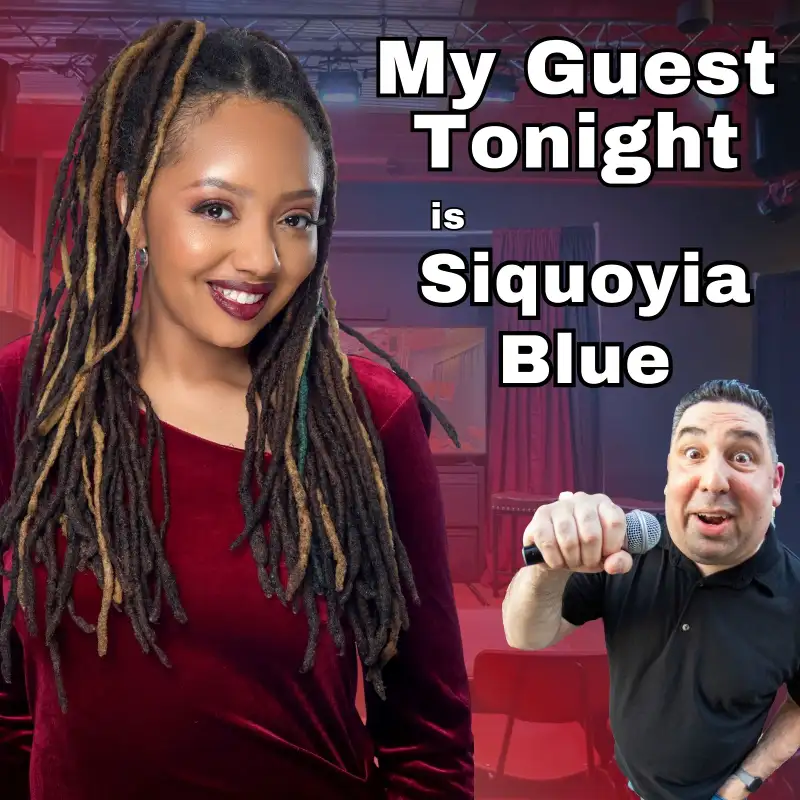
Hey, everybody. Welcome to My Guest Tonight. I'm your host, Jeff Revilla.
I've got a great guest joining me tonight. A singer, an author,
a podcaster, a technologist, an entrepreneur.
Ladies and gentlemen, welcome Siquoyia Blue. She's got a
rhythm running through her veins from the
motherboard to the midnight stage
Checking tempo She's breaking the mold Turning
first dates into a lifetime of stories.
Stories told.
Se.
She's keeping it true yeah, we're vibing tonight.
Siquoyia, welcome to the show. Hello. I love
that. That is a cool intro.
It's been a little bit of a. It's been a great welcome. Like an
icebreaker, like, hey, I got this song I wrote for you. And we play it
and it, it does a lot of foreshadowing too. And, and what some people
tell me is you hear the song at the beginning, but we don't know you
yet. But when I play the song in the outro and you hear
all the things that we have talked about and you hear the song again, it
has a whole nother meaning and people really like it when they hear it the
second time. Yeah, I like it. Do you. Did you sing that
or no? I use AI to do that. I'm just a one man
show here. I love it.
That's a good idea. Thank you. That's a good idea. You're
welcome. You're welcome. So glad to have you here. I know we had some rescheduling.
I had an injury and I've been doing physical therapy and we had to move
some things around a couple times. So I appreciate you being flexible and
being able to be here tonight. Yeah, thanks for having me.
Absolutely. And people watching and listening, they know that this is an origin
story podcast. So if you're just tuning in for the first time, we like to
go back. We want to see who Siquoyia was, to see who she
became and that little journey, the ups and downs and connect
those dots all the way through. And, and we know that we already mentioned
some of the titles I gave you already. Singer, author, podcaster,
technologist, entrepreneur. We're going to get through all of those in 30 minutes. But
if you go back to your. Your earliest days was
performing and singing like when you were a child. Was that really
your. Your first inspiration? Yes. I'm just gonna be quick with
it because I could talk a lot. But yes, that was my first inspiration,
was my music. And, and that was the thing that I thought I was gonna
just do alone. Like, I thought all I was gonna be able to do was.
Was my only talent. So, yeah, I started singing at a young age
at like 7 years old, and then started taking it seriously
around 13, 14 or 15. And that's when I
started, like trying to figure out how to make a career out of it somehow.
But I didn't know nothing about the industry or anybody. Were
you always like performing for friends and family and, and bringing people
over to the house like, hey, I'm gonna do a show at 7 o' clock
tonight. Were you doing a lot of those types of things as a child?
It was strangers. It wasn't anybody. I. It was, it was. I
was in a daycare as a daycare kid, so I was always at the YMCA
just singing, you know, to the kids or rapping. I memorized raps or
whatever. And I would just entertain people because I felt like the bullies would get
quiet when I entertained them. So that's what I used to do.
And there'd be different daycares and then. And sometimes I
of course, perform for my mom. Like, my mom would support me and she liked
to. Told me to practice different songs, but it was mainly, you know,
daycares. In the early years.
Were you thinking of not just like pop hits and things you heard on the
radio and trying to emulate them? Were you also coming up with
your own songs and your own words and telling your own stories?
Yes. So I was a. I didn't, I didn't know
back then I was, I was writing stuff, but it didn't occur to me I
could write. It was like I was writing stuff for school. But then I wrote
my. My first song. I was like. I wrote a lot of songs in my
journal, but I think the first thing I put out was Chocolate man. I was
15 years old and I wrote this song. Fontana, California. My mom. My mom
was doing a nursing contract out there and I just, I felt
inspired. I had a young lady out there that inspired me. Like, my music calm
her down. So she kind of pushed me to write and I did. And
that was my first song I ever written. And whenever,
you know, when you weren't in daycare anymore, when you started school and you
had, you know, nights and weekends, did you start performing at
venues or. I had stage fright. So I really was on and off with it.
I had very bad stage fright. I'm a shy. I was a shy girl. And
I'm still so shy now, but not like I was back then.
My early years, I was so shy. I was a shy, awkward kid. So
I really didn't start Performing till probably high
school. I went to Woodside School of Performing Arts in Virginia. So I
started, like, doing poetry and singing at the talent show.
So that was like my introduction to do it, but I still wasn't 100 with
it because I was still shy. So I didn't perform as much as I could
have, but. But that was my
experience until I went to college first. College, you know,
was college a place where you started to get more comfortable on stage?
Yeah, my first college or Suvalanta, I was like, I want to go to school
for audio productions. I said, you know, a lot of times, you know, you try
and do music, people are like, oh, it might not be a job in there,
you know? So I went to arts to Atlanta, and I started
doing more performances there. I used to farm at a coffee shop called Urban Grind
in Atlanta down the street from where I used to stay at. And so that
was like my thing. Every Thursday night, I would go either sing or do a
poetry or do both. And it was relaxing. It was, it
was that introduction was there. Was there a moment, one of these, you
know, nights out at a club or a restaurant, a bar, where you
started to realize, hey, maybe this is more than, you know, just something I love
to do or more than just a hobby. Was there anything that jumps out at
you? It was really. When I was 15, when I first wrote the song Chocolate
Man, I was like, okay, I want to perform this. And then when I went
to my first college, when I was performing at Urban Grind Atlanta, I don't know
if that's still open. That'd be interesting. But I used to perform there all the
time. And it was that moment where I was like, I want to do this
full time. You know, I don't want to be at a regular job. And, like,
I wasn't a nine. It didn't feel like I was a nine to five girl,
but. But yeah, that was the moment where I was trying to take it seriously
and give me a, give me a gig or something.
And after you developing the gigs and your own style, did, did you,
did you come up with a style or, or merge genres together to,
to come up with your own sound? It was crazy because in my early 20s,
you know, it was always, you, everybody's in a niche. And I realized it
wasn't about just music, but people want to always knit you down. So they were
like, oh, you know, you need to do R B, like, do some pop,
you know, whatever was popular at the time. And I, I,
I was following the trend. I Was trying to do it because I didn't think
I could do anything else at the time because all I knew was music and
writing my music. So I said, okay, I'm gonna try to do this. But then
I didn't like it. I got bored. I didn't like trying to be somebody I
wasn't. I was trying to. And music industry is tough, you know, so you. You
have to like it because it's work and you deal with a lot of people.
You deal with a lot of stuff that's going on, and you don't want to
end up doing something you don't want to do and be stuck. So that was
when I changed and started changing my genre around
25, 26, when I figured out who I was with music. Is
that where you coined the term the abstract soul is? Yeah, 20. I think
it was 20. Yeah, 26, 27. I said abstract soul. I put my
foot on it because I didn't want to say avant garde because I
felt like I wasn't weird enough for avant garde. But I
was like I was dancing on the. On the line of it because some people
thought my music was out of. Out of the box. But
when you, you know, get all these streaming platforms, you realize you're pretty much not
out of the box. A lot of people that saying they're doing all out of
the box stuff. So you're not the only one. So that's when I was strong
enough to push abstract soul in hopes of maybe others can come out and be
who they truly are. And you're doing this while you're going to college. Was. Were
you still studying the arts in college or had you pivoted your. Well,
no. So, yeah, so the Orange Souvena. I didn't even finish that school
because it was a predatory school. And I got. I didn't. I didn't know I
was doing. I went to a college. I didn't want to go to Clayton because
it was Clayton State or Ar Sounda. And I just didn't want a
normal school. I was like, I want to do some hands on. So I thought
that that was the route, the only route, because I didn't know anybody around me
that did music. So my folks were nurse practitioners. So
then I said, okay, let me. Let me go on ahead and.
And go to Aranta. And then I got. I got beat up. I'm not beat
up, but, you know, I got played and I didn't finish that particular school. So
after that, you. I'm pursuing music more at that
point. And at, at some point you
come across with this career in, in it. And I was
seeing if, if it was that right after the college years, was it during
college, how did you get involved into that space?
Unbeknownst to me, I was always technical. Unbeknownst to me. But I didn't know. I
thought tech was Harvard, mit, you know, I didn't
think that I could do it because in my mind I didn't like school. I
really didn't. And then, so what happened was I
think I was 27 and there was a
program and I ended up applying to a Pacific
Tech Institute, Pacific Technology. And I
didn't. Technology was not on my drawing board, but I knew how to do technology.
And then I went to the program was a three month intense program. The government
paid for it. And I came out and my salary jumped
up and I was able to just be more of me and music. And I
had a lot of people, I say, oh, well, you shouldn't do more than one
thing. But I realized that some people have to
do multiple things, you know, especially one that doesn't want to be under
someone's mercy. I want to be, I want to be in charge, you know, I
don't want to be at someone's mercy. So tech was my way
to be free. With music.
And you talk about this balance between art and tech and.
And there are some similarities and some crossover. Sometimes being in it, you
got to be creative to think of solutions, the people's
problems. So, you know, how do you balance that or. And do these worlds cross
at all? They cross and it's crazy because people
wouldn't know. They think you're doing something totally different, but they're all together. And I
remember at the time, my mentor at the time said, you know, everything's connected,
they're all together. And I started getting more into. When I
started working in tech and all that, my left and right brain worked for me.
I was able to come up with stuff quick. Like, because
I'm an artist, I make stuff from out of nowhere. So tech was the
same way. Things were made up by a rule. You can follow the
rule or you can change the rule. So it's the same thing of creating your
own, your own situation in tech. And
you see that, you know, maybe the art inspires the tech, but does the tech
also inspire the art? You know, thinking different out of the box
at work, does it also inspire your art? Well,
I don't think work inspires my art, but I do think technology inspires my art.
Like regular jobs don't. But when it comes down to like the 9 to 5,
you know, is a 9 to 5. But when it comes down to tech itself,
I always say music is my husband and tech is my side piece, you know,
because that's what I say. Music is my husband, Tech is my side piece
because tech just helps me with the music
side and draws me together, made me a better engineer, made me to experience
experiment more. Because my. My other. My latest song, Whiskey, I
was the producer, I created the beat. And that was something. And I
wasn't someone that's classically trained to be the
best audio engineer. I just went by vibes and intuition and
how I do in tech. I'm pushing buttons, I'm going to figure out why, I'm
going to click the button and see what happens. And that's the same thing with
audio engineering. It's like my tech helped me with. That side
to do that Singing, you're studying. I t. You
got it professional. You don't stop
creating at all. You pick up pen and paper. You start writing during
this time too. Tell us a little bit about some of the stories and. And
books that you've written. Well, it's crazy because, like, during
a time when I. When I had to leave the. My first college, I got
depressed and I said, well, I need some creative outlet. I couldn't afford to go
to studios and stuff. And then at the time, you know, a lot of people
were hitting on you at studios, so you didn't want to go by yourself, your
parents working. So I said, you know, let me do something to get this energy
out. So I created my first book that it was a
romance thriller. And I came up the idea when I was working at the airport,
because I was working at airport after I left our Suvana. And I remember this
lady comes out the. The airport, out the off the plane because I was a
wheelchair assistant. I was waiting on my passenger, she was coming out the plane and
she was just so gorgeous. In Rico, I just imagine her life. I said, man,
she looks like she got it going on. I would like to be like her
when I grow up. And I was only 20 years old. So I created a
whole story around her of what her life would be like. And I called it.
The first title was A Woman's Chocolate Appetite Becomes Enslavement. But now it's
called Dark Obsession. It's called Dark Obsession. And when I
first wrote it, I didn't know crap about editing because I was a singer, you
know, I didn't know what? You know, I was like, I just knew I'd write
a story. Okay, put it on. I didn't think anybody would find it on Amazon.
They did. I got brutalized because people say my editing was bad, so
that. So then when I got to tech, that's when I was able to fix
the book. So the book is now fixed. Nobody has a problem with it because
the story itself was good. It was always good. But I just needed a big
boy editor, and I only could afford that when I got into the tech realm,
I was able to buy to pay the big boy editor. And
then. So that was my first book. And then I wrote a children's book called
Sammy Bean. It was about bullying. And it kind of took you back to this
nostalgic playground situation. Before kids had phones and, you know, they own
iPhone. Kids were in a playground chilling and trying to fit in. So,
you know, that's about a. A boy named Sammy Bean trying to bully Monty
King, and Monty's not having it, and he kind of brings peace into the playground.
So that was my children's book. That one did fine because that one was edited
by somebody professional. So that one did really good. I still could push it
more, and that's why I'm doing this podcasting.
And then I did two coloring books. So I did two coloring books that I
released. This was recently released, like, maybe, like two years ago.
I said, let's do an adult coloring book, because a lot of people are stressed
out, you know, and it's a lot going on. People have a lot going on.
And I said, sometimes you need something to just focus on. And I felt like
the coloring books were great for adults and kids, too, if they want one, but
it's for adults. Did the lead character
in your children's book, did he borrow any of your superpowers from
your time in daycare? Was entertaining, kind of the way
that he handled the bullies. It's crazy, because I have
another children's book called. It's another children's book. I can't remember the name
of it. Was it called. Well, I didn't write that. That one's not out yet.
But that one's about music. Monty King is just. It's magical
fantasy. So it's like more fantasy, you know, But. But
yeah, the other. The Soul Brothers, my other children book that I'm gonna be putting
out. That one is musical. It's
magical. So I'm excited about that one whenever I can put that out, trying to
see when. But that one's Good. And between all of
that, you've come up with this board game or a card game.
Yeah, the Dating Assassin game, which I was reading
through some of the cards. It's a great, like, little icebreaker.
I didn't buy it yet. No. You have
pictures of the cards online? Oh, oh, oh, yes, yes. I can see some
sample cards. And, you know, I've been married 20 years.
I'm not doing any ice breaking anymore. But the, the
questions were great and they're a great way when you're just meeting
somebody to kind of break the dice and get to know people pretty
quick, you know, you can get some good answers right away. Yeah. What was kind
of the, what was the inspiration behind creating Dating Dating
Assassin? Well, it's crazy because I was a gamer all my life. I
love games. I, I, you know, I was, when I was a kid, I would
play Sega Nintendo and I was beating everybody. I was a beast. It's always love
games. And then in 28, in
2017, I had, I got a really bad relationship and I said, what
would it be if I could like, ask the right questions and blame it on
a car game? You know, because I feel like a lot of people get in
situations and they didn't ask the right questions. So that's why I created that car
game. And then I was working LA at a tech company in 2018, and I
remember the guys were talking there. I was only woman in there. So that's why
I said, this is questions that guys want to know too. Believe it or not.
Sometimes people think it's just women, but no, these are quite, these are men that
said they want to know. So I asked a few men in there what they
want to know about the woman they're potentially trying to get with. And they told
me. And then I had my own. And I asked the women, and then I
asked my mother that was, was married for like 20 years before her husband died,
and she told me some questions she would have liked to ask her husband. So
I put all these things together and created these 150
questions to vet the potential partner. But I didn't want to be, I wanted to
be light but serious too, because, you know, people act like I think one person
on Amazon. Oh, well, you know, nobody wants to know if somebody has a dog
or cares about a dog. First of all. Yes, they do. People will break up
over. If you watch Married at First Sight right now they are, they were arguing
about a dog. So, yeah, they want to know, do you have a dog or
a cat? Or do you care about dog or cat? Like the. The point
is to invoke communication, even if, even if the question is like you
already knew it. The point is to say to, to elaborate
and it's to bring something out that maybe you're hiding. And that's what we're
trying to do. Have you had any reports of people using the
game in ways you didn't anticipate? Does or
are people doing anything different with the cards than you expected?
Well, I just had someone say that they were taking shots. So if someone didn't
want to answer the question, they just made them take a shot. So,
so you can add the shot part in there if you want. I think people.
Here's the thing. Once you get the game, you can mix it up the way
you want. You can, like it's so many different ways you can do it.
I mean, and so I think that, that, that's the thing about it because people
be like. And I had to update the instructions maybe a year ago. So people
can know that. Because some people think that you have to do it the way
I say do it. But it's. Once you get the game, it's your game. Mix
it up, do your thing. Any, any
love connections that have come from the game that. Has anybody written? You say that
we had the best first date all because of Dating Assassin? No, I
haven't yet. I mean, it'd be nice. Tell me, because I've got, I've had people
buy it, but I don't. They're not say anything. I mean, you know,
I mean, it'd be nice to get. And that's why I'm trying to market more.
I'm not gonna say I'm a one man, I'm a one woman show with this
card game. If I had more, I guess investors, something like that, I
probably. It would be pushed more. So I just think that that's the
downfall of it right now is being a. But there's no time to start a
business, no best time. So I want to start now so I can just learn
it and get it out there. But yeah, if I had more, I guess
marketing dollars, it would probably be bigger.
So you have all these titles. I was giving you the. The podcaster,
entrepreneur, artist, technologist. How are
you still keeping these identities, you know,
moving forward and independent and maybe they are influencing
each other in some way. But you know, how do you manage all this?
Well, here's the thing, you know, with AI and then me being a
multi, I can, I can do multiple things. At one time. But also
everything's not at the same time. So music I don't do
every day. I might write down something and say, okay, I'm gonna do this, but
I have a recording time that I say, okay, I'm gonna record this on this
day or two days and work on this song, and that's that. But I don't
have to sing every day. I have a studio in the house. I have my
own studio, like a, you know, small studio. Because now with technology, you don't need
a big studio. You just, you know, need have good equipment. So I have a
good studio. And then the card game. I just keep consistent
posting. I do. I have AI Help me. I created my own Dating Assassins GPT.
If you guys don't know, GPT is. It's like a little AI helper that you
can create using open AI. And so she. She. I call her she,
but she creates my content for me, and I post it on Instagram,
I correct it, or whatever I got to do. And I kind of set a
schedule out for consistent posting. So when I do run an ad, it's already
enough content they can binge on. And then.
And that's that, I think. And then everything else is
like, you know, nine to five, nine to five. It's all, you
know, once you off work, you do your thing, but everything is. Is set up.
And I make time for myself because one thing I had to learn, I do
watch my movies. I love movies. You listen to my podcast, you'll probably know I
talk about movies because I feel like it relates to life, because my podcast is
about challenging your perspective. And so. But
I do need to make more time for podcasting because that one is more,
I guess, getting. It's just more energy than everything else is
because you have to. It's a lot of people that want to join and interview,
you know, you want to be on the show and stuff. And I've been doing
a lot of solo episodes because it's easy for me to just jump on the
mic and not show myself and just talk. But I know that I do want
to interview guests sometime, and I do want to do that. And that's one thing
I'm slacking on. So I am going to get into that. But yeah,
that's how I balance it is everything is all at different times. And do
you find podcasting as another creative outlet? Like, maybe, you know, you're
working all day, you're coming home, maybe tired, but. But podcasting
allows you to get those thoughts, those ideas, out into the real world.
Yes, it really does. Like when I talk about. Because I love books and
stuff and, you know, and lately I've been reading more and all this stuff and
I'll share my perspective of the story and how it relates to society and
culture. And so that's what I do. And it's,
it's amazing. It's like, it's like a release. So it's a dopamine hit
in a way. And I'm not paying for any ads for it either. Like, I'm
not mark like paying for ads or nothing. I'm just sharing it and
that's it. Sharing on Instagram and stuff. But yeah, no
marketing for it. And what kind of advice, you know, I mentioned
these titles a couple times already, but what would you give to, you know, somebody
up and coming, a new creator, somebody who has these ideas and
doesn't know what the start or how to start? You know, what kind of advice
maybe would you give yourself, you know, a few years ago to, to keep
trying new things, new creative outlets, you know what? Well, for the new
person out there, I would say go do it. I mean, there's never a perfect
time. And then have, and then research strategy.
Understand marketing. Don't just, just because you have money don't mean you're going to blow
up neither. So you have to understand marketing, who your audience is and what you're
trying to do. And then you got to believe in it. You got to stand
10 toes down and you gotta do the work and it doesn't have to be
24 7. Learn automation, learn AI, learn processes and procedures. And
then you don't have to be sitting around doing it all the time for
whatever you're trying to do and just, and just believe in yourself and do it.
There's no perfect time. And then for me, what I would recommend for myself
in the past is to, I, I don't, I don't think I would change anything
because I wouldn't be where I'm at now. I wouldn't have learned what the heck
I learned. But I would say just stay
confident. And I would always, in the past, my tell my past self, stay confident,
man, because life is gonna beat you up. Stay confident and move. Keep
moving, regardless. You mentioned the book coming out
soon, another children's book coming out. Yeah. What do you have, what do you
have working on next? We're. What's Siquoyia gonna be releasing and working on in
the next, you know, two to three years? Oh, man. Oh, Lordy.
Well, you know, What? It's crazy because I want to say two, three, you know,
I want to say, but, you know, you know, things change and shift. But what
I want to do is definitely, you know, do some more podcasting. Get. I might
start Dating Assassins podcast because it's going to be, you know, an
interview and dating people only. It's dating people, it's dating stories
and then ask questions from the card game to the, the people that
join and promote the game that way. But also people get to hear stories
and stuff. I'm continuing my bloggers
podcast. I'm trying to continue posting weekly, rather solo, are with a
guest and continue doing my
tech stuff. I love tech. Like I said, it's my side piece. I'm always gonna
be studying my tech, my search, my training and in adding it
to continue to grow Dating Assassins, I use it in into my
music. I do want to do another song soon. I want to do another single
and I'm going to be working on that too. So I want to work on
another single that I produce. But yeah, that's it so far
for the next two years. But I hope to move. Shoot for the moon. Yeah,
shoot for the moon. I do think that, I think your idea for a Dating
Assassins podcast is a great idea. I, I think you could get some
traction with that. I was thinking that too. I mean, I said. And it's just
that I just gotta like figure out, okay, the timing stuff. And I'm gonna use,
you know, of course Pod Match to get the people because I don't want to
use influencers. And going back, I don't know if you're at a backstage, but you
can hire different people to do stuff. But I'm gonna stick to
podmatch, so I'm gonna have two accounts. So soon I'll be the. The
Dating Assassins podcast will be on Pop Match for all the dating
gurus can join and all that stuff. And it's just going to be about dating,
but it's not going to be as consistent as this. The block podcast will most
likely be like twice a month interviews. Yeah. And that's
that A great way to promote the, the game and to show people, you know,
you're actually using it in real time so people get to see how it works
and they might think, oh, this would be a great thing, you know, for my
partner or my spouse. Yes. Another thing I want to say is
I do want to do a tech card game. Not card game, but tech
knowledge deck in the future. So I am gonna, I'm gonna do
that in the future, once Dating Assassins get out there a little more, I'm going
to do that. Awesome. And people want to follow
along and keep up with you. What's. What's the best way to get in contact
with you or to reach out to you? Well, my Instagram
is Blockman's podcast, and you just go to. In my Instagram bloggings podcast.
And you can also go to Dating Assassins Instagram
as well. So both of those you'll get me. And
then my sub stack, I just started sub stack, so you can.
You can subscribe there. I'll keep you updated. I put all my episodes on
Substack, which is all new to me. I just started learning Substack, so everybody's doing
it evidently. So I'm like, okay, let me do it too. So people join and
follow. So I have two sub stacks. So I have Siquoyia Blue, which is for
the music side and the AI side. And then I have
Blockers Podcast, which is for the podcast side. So it's two different newsletters in there
when you go. And all that's in my. Call Me. My. My link tree that
I. That I have. I think it's Siquoyia Call Me IO. I think.
Yeah, the links will be. Yeah, it should be on
Pod Match. Yeah, yeah. And check the show notes of this show. This will be
on YouTube in your podcast app. Check out Siquoyia's links.
Follow along. This is an amazing story. A lot of things, A
lot of hats. Right? We're wearing a lot of hats. And. And that creative process.
Some people like. I like I have to do things all the time. And I
can 1000% relate to you, Siquoyia. You need those
outlets. And it's so healthy and it's so much fun to be able to create
these things and put them out in the world. And this has been a great
half hour. Siquoyia, thank you so much for joining us.
Thank you. I had so much fun. And thanks, everybody, for listening.
Let's go back to that theme song. She's got a rhythm running
through her veins from the motherboard
to the midnight stage Taking Tambo
she's breaking the mold Turning first dates into
a lifetime of stories.
Stories.
True from heart to machine she's keeping it
true yeah, we're vibing tonight.